In Cesuna, on the Asiago Plateau, the beech and fir woods hide trenches, war cemeteries and paths that climb up to the pastures. A century ago one of the hardest battles of the Great War was fought here; today it is one of the quietest places in the Veneto, ideal for walking, reflecting and tasting cheeses from the mountain pastures.
Why visit Cesuna and the Plateau
The Plateau of the Seven Communities
The Asiago Plateau, at about a thousand metres above sea level, is also called the Plateau of the Seven Communities: Asiago, Roana, Rotzo, Gallio, Foza, Enego and Lusiana Conco. For centuries it was a small mountain republic, inhabited by the Cimbri, a people of Germanic origin who spoke an ancient language still remembered in place names. Cesuna is a village in the municipality of Roana, one of the centres of Cimbrian culture.
The places of the Great War
In 1916 and 1918 the Plateau was a front line. The woods around Cesuna preserve trenches, gun positions and tunnels, and some of the British military cemeteries where the British soldiers who fought here are buried. In Asiago, the Leiten War Memorial holds the remains of tens of thousands of fallen soldiers. These are places of remembrance and prayer, to be visited with respect.
Paths and nature
The Plateau is crossed by hundreds of kilometres of footpaths, forest tracks and cycle routes. You walk through woods, mountain dairies and pastures, up to viewpoints overlooking the Venetian plain. In winter the same routes become cross-country ski trails and snowshoe itineraries.
The flavours
This is the home of Asiago PDO cheese, fresh or aged, made with milk from the mountain dairies. In the right seasons you find mushrooms, berries and honey, and in the mountain trattorias you eat gnocchi, polenta and game.
The surroundings
- Asiago: the main town of the Plateau, with the Cathedral of San Matteo, the Leiten War Memorial and its shopping streets, a few minutes from Cesuna.
- Roana and Canove: museums devoted to Cimbrian culture and the Great War.
- Forte Corbin: an early twentieth-century Italian fortress, perched above a sheer drop into the Val d’Astico.
- The mountain dairies: in summer many open to visitors and sell cheese and butter.
- Marostica and Bassano del Grappa: going down towards the plain, the square of the living chess game and the Alpini Bridge.
| From Cesuna to… | Approximate time by car |
|---|---|
| Asiago | 10–15 minutes |
| Roana and Canove | 10 minutes |
| Forte Corbin | 20 minutes |
| Bassano del Grappa | About 1 hour |
| Vicenza | About 1 hour |
When to go
Summer is the season for walks, open mountain dairies and cool air: in July and August temperatures here stay pleasant. In autumn the woods change colour and people gather mushrooms and chestnuts. Winter brings snow, cross-country skiing and a silence that is perfect for a retreat.
Where to stay
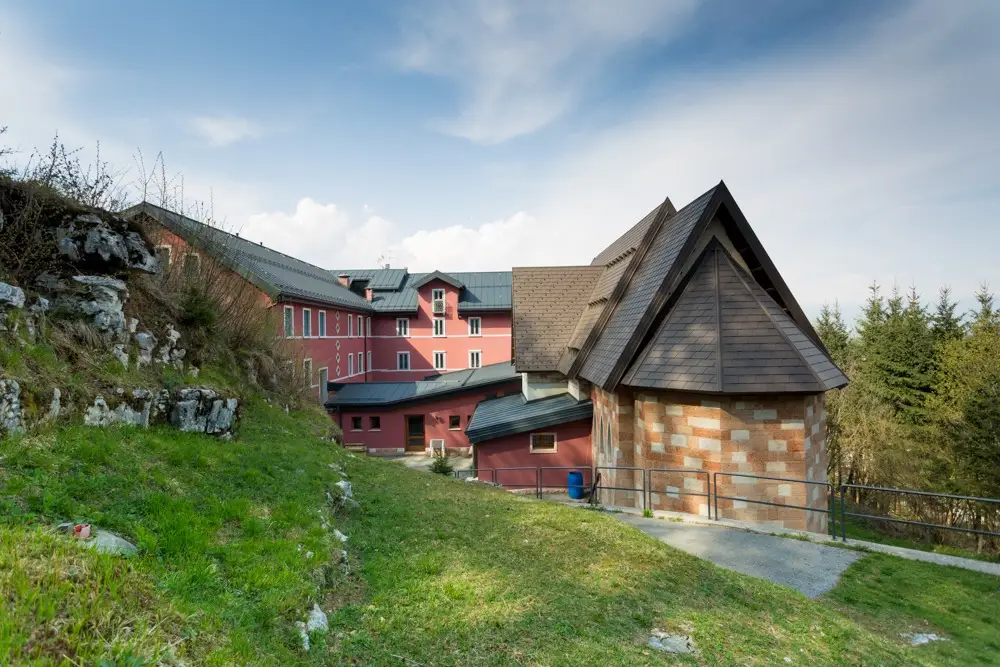
Villa Tabor stands in Cesuna, surrounded by beech and fir trees, and has been entrusted to the Daughters of Mary Help of Christians since 1943. It is a house devoted to the spiritual life of young people and adults, with 15 rooms, a votive chapel, a lift and free parking. It hosts formation weekends, weeks of spirituality, spiritual exercises and holidays, and offers the chance to share moments of prayer with the community of sisters.